The Affect of the Black Death in Virsual Art
What plague art tells u.s. nigh today
How accept artists portrayed epidemics over the centuries – and what can the artworks tell usa about then and now? Emily Kasriel explores the art of plague from the Black Decease to current times.
A
As their communities grappled with an invisible enemy, artists have often tried to make sense of the random destruction brought by plagues. Their estimation of the horrors they witnessed has inverse radically over fourth dimension, but what has remained constant is the artists' desire to capture the essence of an epidemic. Through these artworks, they accept recast the plague as something not quite as amorphous, unknowable, or terrifying.
More like this:
- The symbol that sums up our times
- What do our dreams mean?
- The plague writers who predicted today
Throughout most of history, artists take depicted epidemics from the greatly religious framework within which they lived. In Europe, art depicting the Black Death was initially seen as a alert of punishment that the plague would bring to sinners and societies. The centuries that followed brought a new role for the artist. Their task was to encourage empathy with plague victims, who were later associated with Christ himself, in order to exalt and incentivise the courageous caregiver. Generating potent emotions and showing superior strength overcoming the epidemic were means to protect and bring solace to suffering societies. In modern times, artists have created self-portraits to show how they could endure and resist the epidemics unfolding effectually them, reclaiming a sense of agency.
Through their creativity, artists have wrestled with questions about the fragility of life, the relationship to the divine, every bit well as the role of caregivers. Today, at a fourth dimension of Covid-19, these historical images offer united states a run a risk to reverberate on these questions, and to inquire our ain.
Plague as a alarm
At a fourth dimension when few people could read, dramatic images with a compelling storyline were created to captivate people, and impress them with the immensity of God'due south power to punish disobedience. Dying of the plague was seen not only as God'southward penalisation for wickedness merely as a sign that the victim would endure an eternity of suffering in the world to come.
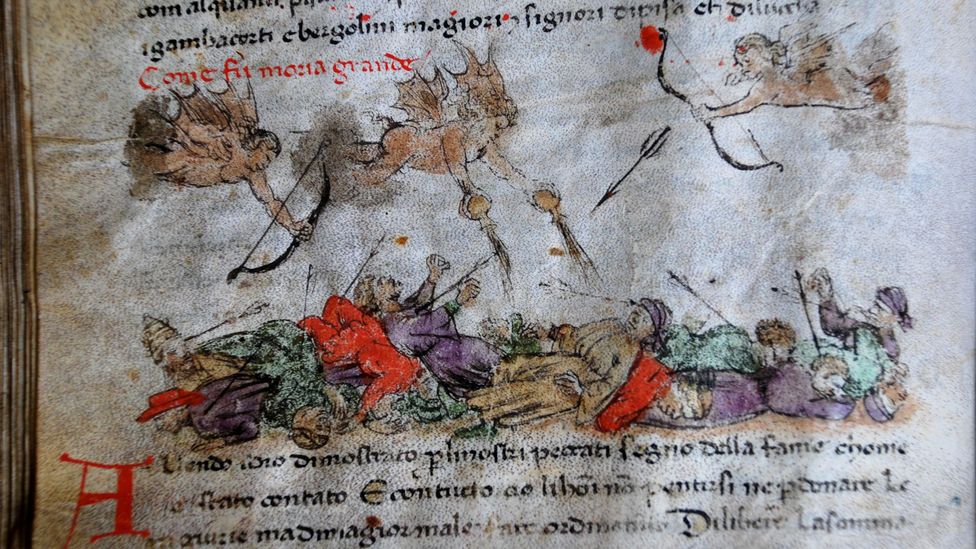
This early on illustrated manuscript depicts the Black Death (Credit: Courtesy of Louise Marshall/ Archivio di Stato, Lucca)
This prototype is one of the first Renaissance Art representations of the Black Death epidemic, which killed an estimated 25 million people in Europe during its most devastating years. In this illustrated manuscript painted in Tuscany at the end of the 14th Century, devils shoot down arrows to inflict horror upon a tangled mass of humanity. The killing is portrayed in existent time, with one arrow about to hitting the caput of one of the victims. The symbol of arrows as carriers of affliction, misfortune and expiry draws on a rich vein of arrow metaphors in the Sometime Attestation and Greek mythology.
Australian art historian Dr Louise Marshall argues that, in illustrations like this, devils are subcontracted by God to castigate humanity for their sins. Medieval people who saw this paradigm would be terrified by the winged creatures because they believed devils had emerged from the underworld to threaten them with incredible powers.
This portrayal shows u.s. the devil's slaughter as indiscriminate, emerging out of the corrupted atmosphere of the dark clouds to target the whole community. "The image acts as a warning about non only the loss of a community but the end of the world itself," says Dr Marshall. In this understanding of the plague, the apocalypse is laid on for humanity's ultimate do good, so that we can learn the error of our ways and fulfil the divine volition past living a true Christian life.
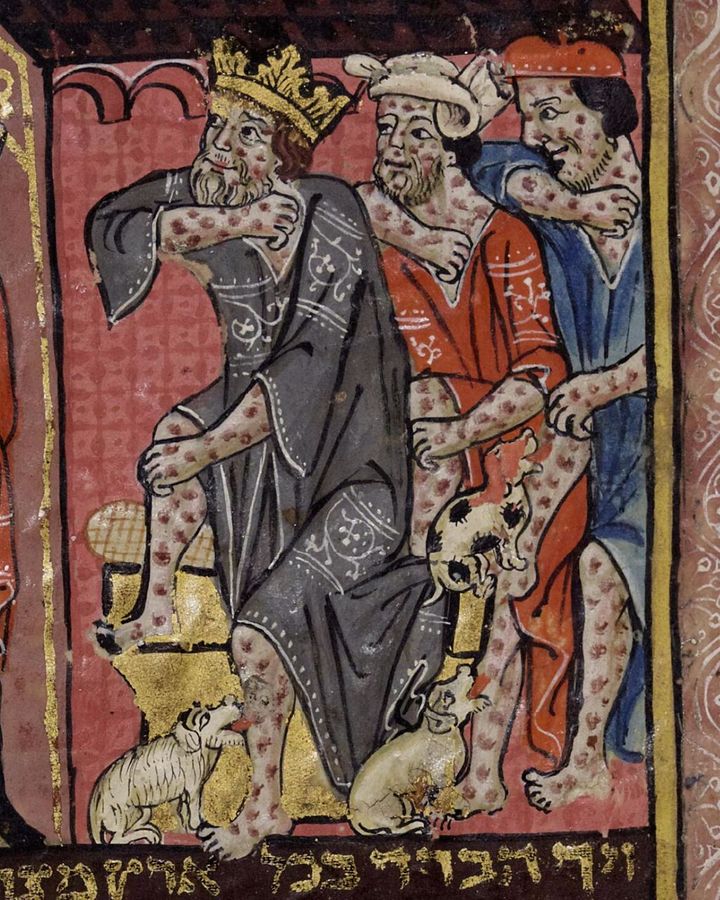
Plague is portrayed as a punishment in this 14th-Century illustration (Credit: Rylands Library/ University of Manchester)
The plague punishment narrative also forms part of the story of the liberation of the Jewish people from Egypt, retold by Jewish communities every twelvemonth at Passover. This image of 1 of the ten plagues brought downwardly on the guilty Egyptians comes from a 14th-Century illuminated Haggadah. The manuscript was commissioned by Jews in Catalonia to apply at their almanac Passover repast. Here, the Pharaoh and one of his courtiers is smitten by boils for their sins of oppressing the Israelite slaves who the Egyptians claimed were swarming like insects. Professor of religion and visual civilisation, Dr Marc Michael Epstein, highlights "the extreme penalty revealed in the particular of this image, the three dogs licking their sinful Egyptian owners' festering sores".
Artworks created during times of plague reminded fifty-fifty the most powerful that their life was fragile, temporary and provisional. In many plague paintings there is an accent on the suddenness of death. The epitome of the d anse macabre is repeated, where anybody is encouraged by the personification of decease to trip the light fantastic to their grave. There is also all-encompassing use of the hourglass to warn believers that they had merely limited fourth dimension to get their affairs and souls in order earlier the plague might cut them off without warning.
Plague inspiring empathy
There was a dramatic development in plague art with the creation of Il Morbetto (The Plague), engraved by Marcantonio Raimondi in the early 16th Century, based on a work by Raphael.
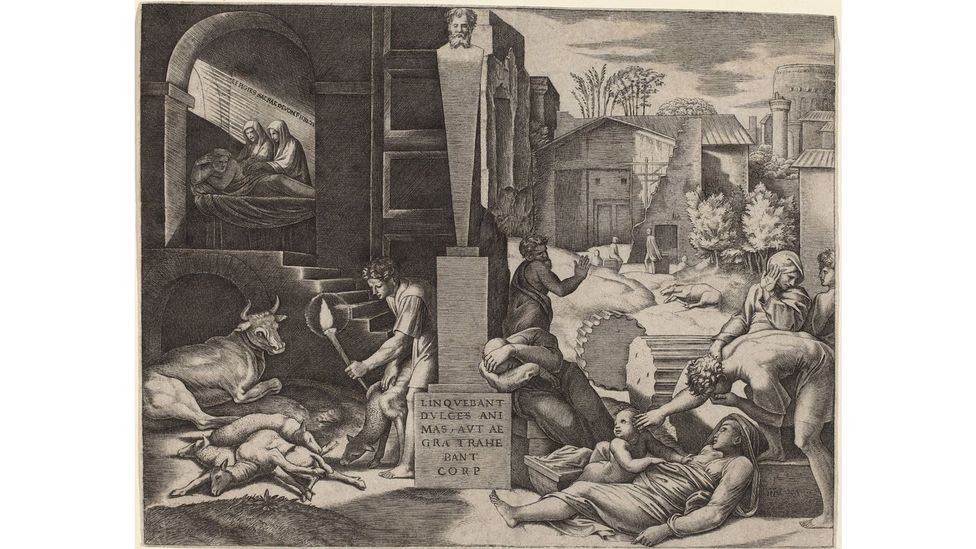
This 16th-Century engraving is by Raimondi (Credit: The National Gallery of Art Washington DC)
According to US plague art historian, Dr Sheila Barker, "what is pregnant about this tiny epitome is its focus on a few individuals, distinguished by their age and gender". These characters have become humanised, compelling u.s.a. to feel compassion for their suffering. We meet the ill being given such tender care that we feel nosotros as well must act to salvage their pain. Here, a piece of work of art has the potential to convince us to practice something we may be afraid of doing – taking care of diseased and contagious souls.
This shift in plague fine art coincided with a new understanding of public wellness. All members of society deserved to be protected, not merely the wealthy who could escape to their country villas. Doctors who fled the metropolis for their ain prophylactic were to be punished.
This empathy theme was further developed in the 17th and 18th Centuries, with the closer alignment of the Catholic Church with a public-health agenda. Plague art began to be displayed within churches and monasteries. Sufferers of the plague were now associated with Christ himself. Dr Barker argues that the purpose backside this identification was "to convince the friars to overcome their fear of the putrid odor of the dying body and the immensity of death by learning to beloved the contagious victims of the plague". Those who cared for the sufferers potentially sacrificed themselves and were therefore exalted by existence portrayed as saint-like.
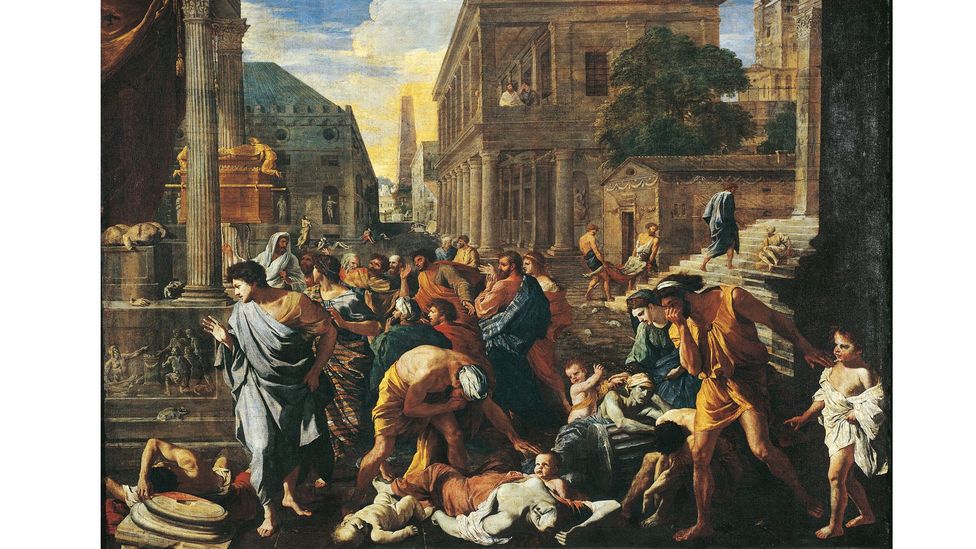
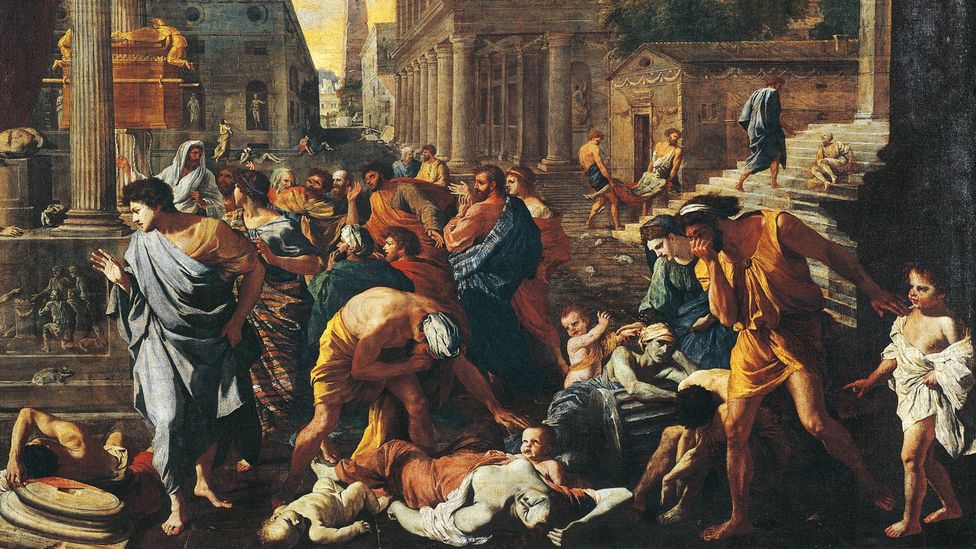
Poussin painted The Plague of Ashdod in 1630-31 (Credit: DEA / G DAGLI ORTI/ De Agostini via Getty Images)
Healing power
In the 17th Century, many people believed that imagination had the ability to damage or heal. The French artist Nicolas Poussin painted The Plague of Ashdod (1630-1631) in the centre of a plague outbreak in Italy. In a recreation of a faraway tragic biblical scene, which provokes feelings of horror and despair, Dr Barker believes that "the artist wanted to protect the viewer against the very illness the painting depicts". By arousing powerful emotions for a afar sorrow, viewers would experience a cathartic purge, inoculating themselves against the anguish that surrounds them.
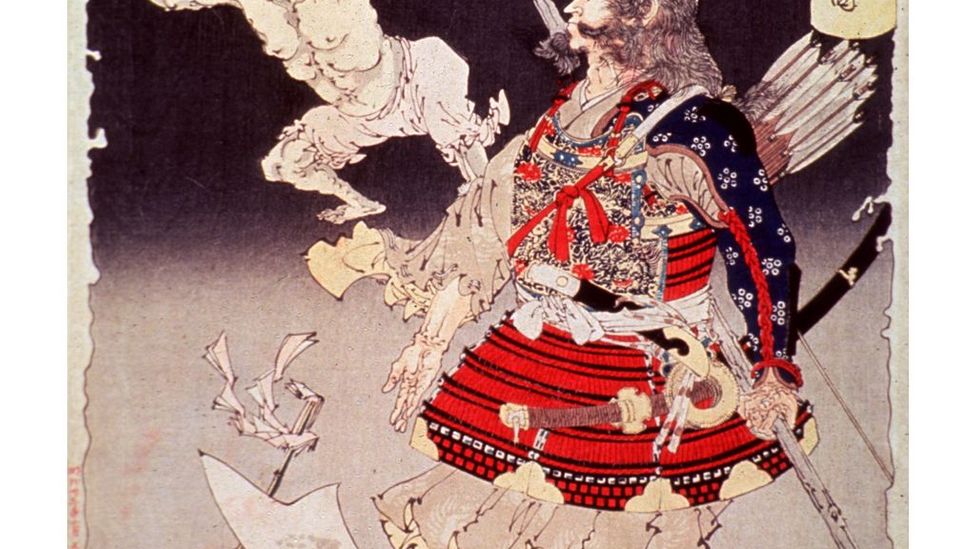
Tsukioka Yoshitoshi's 1892 artwork shows a warrior resisting smallpox demons (Credit: National Library of Medicine)
The plague of smallpox devastated Japan over many centuries. An artwork created in 1892 depicts the mythical Samurai warrior Minamoto no Tametomo resisting the 2 smallpox gods, variola major and variola small-scale. The warrior, known for his endurance and fortitude, is portrayed every bit stiff and confident, clothed with viscerally cherry ornate garments and armed with swords and a quiver full of arrows. In contrast, the fleeing, frightened, colourless smallpox gods are squeezed helplessly into the corner of the image.
Navigating pain through the self-portrait
Modern and contemporary artists accept created self-portraits to make sense of their ain plague suffering, while simultaneously contemplating the transcendent themes of life and death.
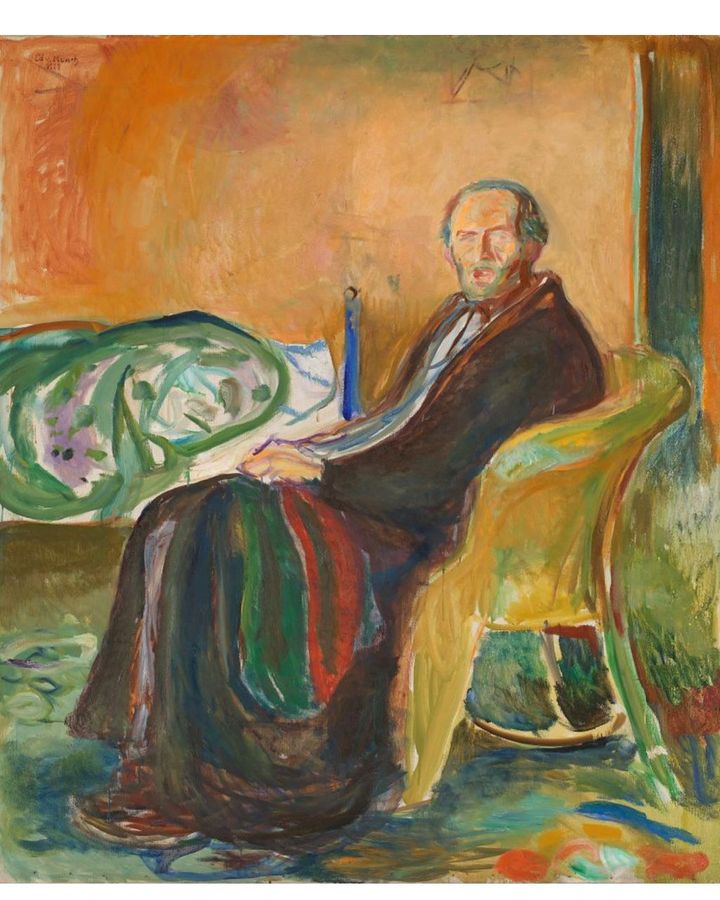
Edvard Munch's Self-portrait with Spanish Flu (1919) expresses the creative person'due south own pain (Credit: Nasjonalmuseet/ Lathion, Jacques)
When the Castilian Influenza hit Europe just after World War Ane, Norwegian artist Edvard Munch became i of its victims. While his torso was still grappling with the flu, he painted his trauma – pale, exhausted and solitary, with an open up oral fissure. The gaping mouth echoes his most famous piece of work, The Scream, and mayhap depicts Munch's difficulty breathing at the time. There is a strong sense of disorientation and disintegration, with the figure and furniture blending together in a delirium of perception. The creative person's sail looks similar a corpse or a fitful sleeper, tossing and turning in the nighttime. Dissimilar some of Munch's previous depictions of illness, in which he portrays the sick person'southward loved ones waiting with anxiety and fearfulness, the artist here portrays himself as the victim, who has to endure this plague isolated and alone.
Usa bookish Dr Elizabeth Outka tells BBC Civilization: "Munch is non just belongings a mirror to nature, but also exercising some control through reimagining it." Outka believes that art serves as a coping machinery here for both the artist and viewer. "The viewer may feel a profound sense of recognition and compassion for Munch'southward suffering, which tin can in some manner help to heal their distress."
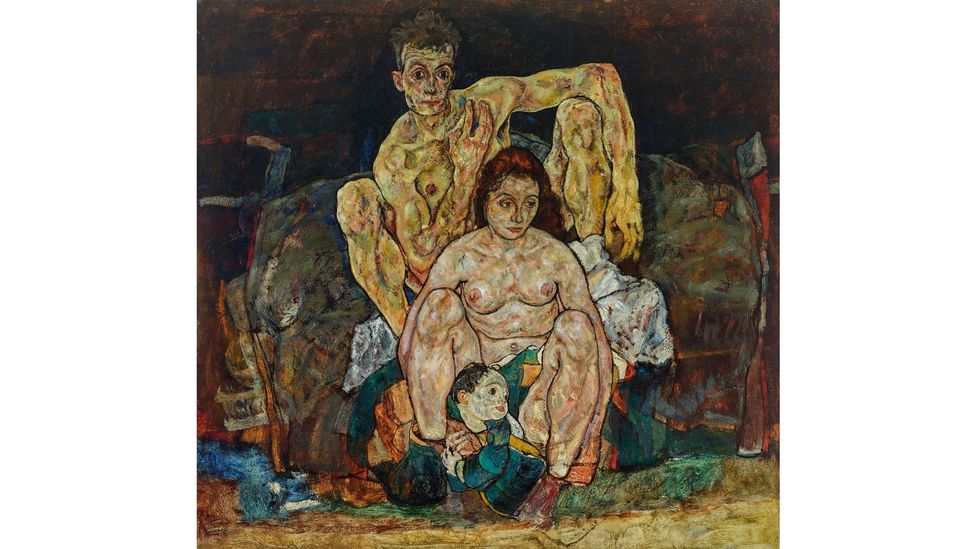
Egon Schiele's The Family, 1918, is total of anguish (Credit: Fine Fine art Images/ Heritage Images via Getty Images)
In 1918, Austrian artist Egon Schiele was at work on a painting of his family, with his pregnant wife. The modest kid shown in the painting represents the unborn child of couple. That fall, both Edith and Egon died from the Castilian Influenza. Their kid was never born. Schiele fastened nifty importance to cocky-portraits, expressing his internal anguish through eccentric body positions. The translucent quality of skin is raw, equally if we are given a glimpse of their tortured insides, and the facial expressions are vulnerable while simultaneously resigned.
David Wojnarowicz was a The states creative person who created a body of Aids-activist piece of work, passionately critical of the US government and the Catholic Church for failing to promote safe-sexual activity information. In a securely personal, untitled self-portrait, he reflects upon his own bloodshed. About half dozen months before he died of Aids, Wojnarowicz was driving through Decease Valley in California and asked his travelling companion Marion Scemama to finish. He got out of the car and furiously started to scrape the globe with his bare hands, before burying himself.
As in the self-portrait by a flu-stricken Munch, Dr Fiona Johnstone, a contemporary art historian from the UK, sees this work as David Wojnarowicz attempting to assert agency. "Here David takes control of his ain fate by preempting information technology, wrestling dorsum control of his illness by performing his own burying," she says.
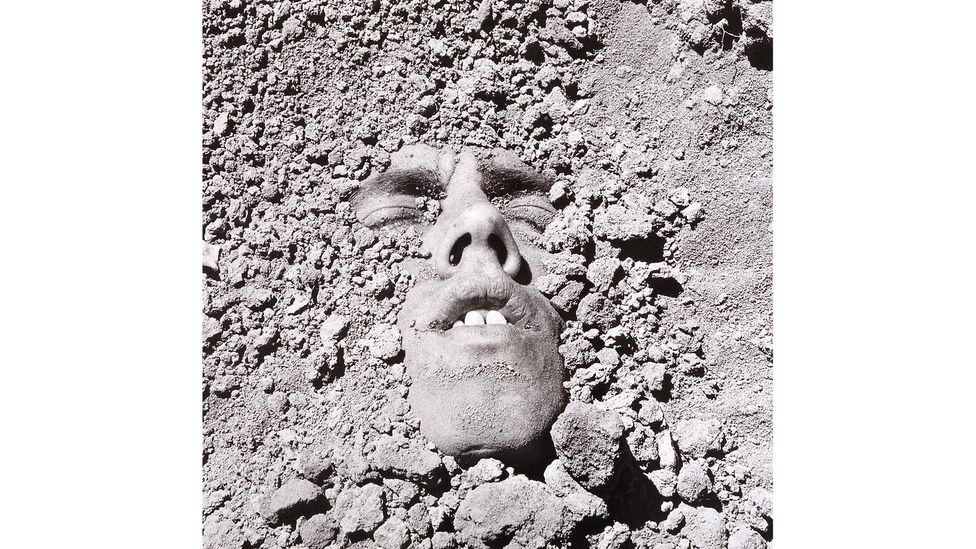
In this untitled self-portrait, David Wojnarowicz reflects on his own mortality (Credit: Courtesy of the Estate of David Wojnarowicz and P·P·O·West, New York)
Today's digital platforms are enabling artists to respond to the Covid-19 crunch by expressing and sharing in real time. The Irish-born artist Michael Craig-Martin has created a Thank You lot NHS blossom poster. We are encouraged to co-create the artwork by downloading it, colouring it in, and then collaborating past displaying it in our window.
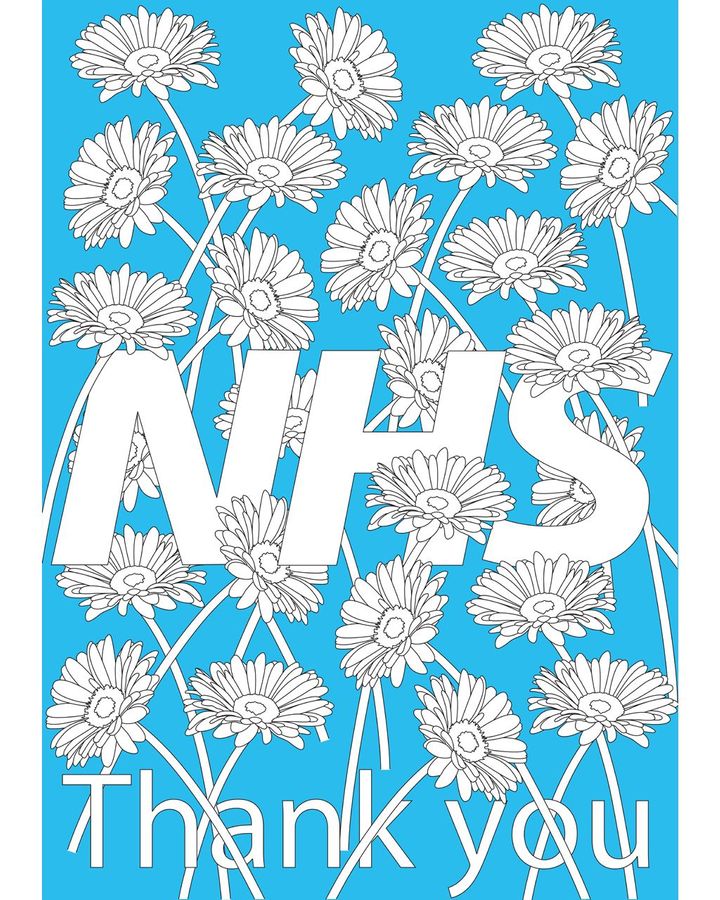
Michael Craig-Martin is among the many artists who have been inspired by the current pandemic (Credit: Michael Craig-Martin)
In countries across the world, artists are slowly making sense of the coronavirus and the self-isolating response in countries across the globe. Gimmicky art historians will be eagerly awaiting their work. We who are living through this mod-day plague will engage with these emerging images; they might even regain some control over an feel that threatens so much of humanity and our globalised lives.
Inquiry by Kate Provornaya
If yous would like to annotate on this story or anything else you have seen on BBC Culture, head over to our Facebook folio or message u.s. on Twitter .
And if y'all liked this story, sign upwards for the weekly bbc.com features newsletter , chosen The Essential List. A handpicked selection of stories from BBC Hereafter, Culture, Worklife and Travel, delivered to your inbox every Friday.
Source: https://www.bbc.com/culture/article/20200514-how-art-has-depicted-plagues
0 Response to "The Affect of the Black Death in Virsual Art"
Enregistrer un commentaire