Mythical God Who Died and Rose Again
| Resurrection deity | |
|---|---|
 The Render of Persephone by Frederic Leighton (1891). | |
| Description | A dying-and-ascension god is born, suffers a expiry-like experience, and is subsequently reborn. |
| Proponents | James Frazer, Carl Jung, Tryggve Mettinger |
| Discipline | Mythology Religion |
A dying-and-rising, death-rebirth, or resurrection deity is a religious motif in which a god or goddess dies and is resurrected.[ane] [two] [iii] [4] Examples of gods who dice and subsequently return to life are most frequently cited from the religions of the ancient Most East, and traditions influenced past them include Biblical and Greco-Roman mythology and by extension Christianity. The concept of a dying-and-rising god was kickoff proposed in comparative mythology by James Frazer's seminal The Gilded Bough (1890). Frazer associated the motif with fertility rites surrounding the yearly cycle of vegetation. Frazer cited the examples of Osiris, Tammuz, Adonis and Attis, Dionysus and Jesus.[five]
Frazer's estimation of the category has been critically discussed in 20th-century scholarship,[6] to the conclusion that many examples from the world's mythologies included under "dying and rising" should but be considered "dying" but not "rising", and that the genuine dying-and-rising god is a characteristic feature of ancient Near Eastern mythologies and the derived mystery cults of Late Antiquity.[7] "Decease or departure of the gods" is motif A192 in Stith Thompson's Motif-Index of Folk-Literature (1932), while "resurrection of gods" is motif A193.[8]
Overview [edit]
The motif of a dying deity appears inside the mythology of diverse cultures – perhaps because attributes of deities were derived from everyday experiences, and the ensuing conflicts often included death.[9] [10] [11] These examples range from Baldr in Norse mythology to the feathered ophidian Quetzalcoatl in Aztec mythology to the Japanese Izanami.[ten] [12] [13]

Odin whispering to a expressionless Baldr as he is to be sent out to sea
The methods of expiry vary, e.g., in the myth of Baldr (whose business relationship was likely first written downward in the 12th century), he is inadvertently killed by his bullheaded brother Höðr who is tricked into shooting a mistletoe-tipped arrow at him, and his torso is then set aflame on a ship as it sails out to body of water.[10] [12] Baldr does not come back to life because not all living creatures shed tears for him, and his decease then leads to the "doom of the gods".[ten] [12]
In dissimilarity, in most variations of his story, Quetzalcoatl (whose business relationship was first written down in the 16th century) is tricked by Tezcatlipoca to over-potable and so burns himself to death out of remorse for his own shameful deeds.[10] [14] Quetzalcoatl does not resurrect and come up back to life as himself, just some versions of his story accept a flock of birds flying abroad from his ashes, and in some variants, Quetzalcoatl sails away on the ocean never to return.[10] [fourteen]
Hawaiian deities can die and depart the world in a number of ways; eastward.g., some gods who were killed on Lanai past Lanikuala departed for the skies.[10] In contrast, Kaili leaves the world past a canoe which is never seen again.[10] The Japanese god Izanami, on the other hand, dies of a fever and Izanagi goes to Yomi, the land of gloom, to call back her, but she has already changed to a deteriorated state and Izanagi will not bring her back, and she pursues Izanagi, but he manages to escape.[10] [13]
Some gods who dice are besides seen as either returning or bringing about life in some other form, oft associated with the vegetation cycle, or a staple food, in consequence taking the form of a vegetation deity.[10] [11] Examples include Ishtar and Persephone, who die every yr.[9] The yearly expiry of Ishtar when she goes underground represents the lack of growth, while her return represents the rebirth of the farming cycle.[9] Near scholars hold that although the gods suggested in this motif die, they do non generally return in terms of rising equally the same deity, although scholars such as Mettinger contend that in some cases they do.[ten] [15]
Development of the concept [edit]
The term "dying god" is associated with the works of James Frazer,[4] Jane Ellen Harrison, and their fellow Cambridge Ritualists.[16] At the end of the 19th century, in their The Gilded Bender [4] and Prolegomena to the Study of Greek Faith, Frazer and Harrison argued that all myths are echoes of rituals, and that all rituals have as their primordial purpose the manipulation of natural phenomena.[4]
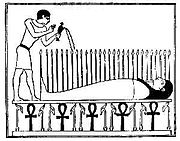
The Osiris-bed, where he renews the harvest cycle in Arab republic of egypt
Early in the 20th century, Gerald Massey argued that there are similarities betwixt the Egyptian dying-and-ascension god myths and Jesus,[17] but Massey's factual errors often return his works nonsensical. For example, Massey stated that the biblical references to Herod the Cracking were based on the myth of "Herrut" the evil hydra serpent. However, the beingness of Herod the Great is well established independently of Christian sources.[18] Massey's scholarship has been widely rejected by mainstream academics, including, amongst many others, Christian Evangelical writers such as Stanley E. Porter.[xix]
The Swiss psychoanalyst Carl Jung argued that archetypal processes such as death and resurrection were function of the "trans-personal symbolism" of the collective unconscious, and could be utilized in the job of psychological integration.[20] [ page needed ] He too proposed that the myths of the infidel gods who symbolically died and resurrected foreshadowed Christ's literal/physical decease and resurrection.[20] [ page needed ] The overall view of Jung regarding religious themes and stories is that they are expressions of events occurring in the unconscious of the individuals – regardless of their historicity.[21] From the symbolic perspective, Jung sees dying and rise gods as an archetypal process resonating with the collective unconscious through which the ascent god becomes the greater personality in the Jungian self.[9] In Jung's view, a biblical story such as the resurrection of Jesus (which he saw every bit a case of dying and rising) may be true or non, but that has no relevance to the psychological analysis of the process, and its impact.[21]

The analysis of Osiris permeates the afterward religious psychology of Carl Jung more than than whatever other element.[22] In 1950 Jung wrote that those who partake in the Osiris myth festival and follow the ritual of his death and the scattering of his trunk to restart the vegetation bicycle as a rebirth "experience the permanence and continuity of life which outlasts all changes of grade".[23] Jung wrote that Osiris provided the key case of the rebirth process in that initially only the Pharaohs "had an Osiris" but subsequently other Egyptians nobles caused it and eventually information technology led in the concept of soul for all individuals in Christianity.[24] Jung believed that Christianity itself derived its significance from the archetypal relationship between Osiris and Horus versus God the Father and Jesus, his son.[22] However, Jung besides postulated that the rebirth applied to Osiris (the father), and not Horus, the son.[22]
The general applicability of the decease and resurrection of Osiris to the dying-and-rising-god analogy has been criticized, on the grounds that it derived from the harvesting rituals that related the rising and receding waters of the Nile river and the farming cycle.[nineteen] [25] [26] The cutting down of barley and wheat was related to the death of Osiris, while the sprouting of shoots was idea to be based on the power of Osiris to resurrect the farmland.[19] [25] [27] In general rebirth analogies based on the vegetation cycle are viewed as the weakest elements in the decease-rebirth analogies.[9]
In Greek mythology, Dionysus, the son of Zeus, was a horned child who was torn to pieces by Titans who lured him with toys, so boiled and ate him.[28] [29] Zeus and so destroyed the Titans by thunderbolt as a result of their action against Dionysus and from the ashes humans were formed.[29] Notwithstanding, Dionysus' grandmother Rhea managed to put some of his pieces dorsum together (principally from his centre that was spared) and brought him back to life.[28] [29] Scholars such as Barry Powell have suggested Dionysus equally an case of resurrection.[30]
The oldest known instance of the "dying god rising myth" is the Sumerian myth of Inanna's Descent to the Underworld . The Sumerian goddess Inanna travels to the Underworld to see her sis Ereshkigal. While there, she is "struck downward" and turns into a corpse. For three days and three nights, Inanna is dead, until she is resurrected with the assistance of her father, Enki, who sends the two galla to bring her back. The galla serve Inanna food and h2o and bring her back to life. [31]
Scholarly criticism [edit]

The category "dying-and-ascent-god" was debated throughout the 20th century, almost modern scholars questioning its ubiquity in the world'southward mythologies.[x] By the cease of the 20th century the overall scholarly consensus had emerged against the category, given its limited applicability outside of ancient Near Eastern religions and derived traditions.[10] Kurt Rudolph in 1986 argued that the oftentimes-made connection between the mystery religions and the idea of dying and ascent divinities is defective. Gerald O'Collins states that surface-level application of analogous symbolism is a case of parallelomania which exaggerates the importance of trifling resemblances, long abandoned by mainstream scholars.[32] Against this view, Mettinger (2001) affirms that many of the gods of the mystery religions practice indeed die, descend to the underworld, are lamented and retrieved by a woman and restored to life. However, Mettinger also disincludes Christianity from this influence.[7]
While the concept of a "dying-and-ascension god" has a longer history, it was significantly advocated by Frazer's Golden Bough (1906–1914). At first received very favourably, the thought was attacked by Roland de Vaux in 1933, and was the subject area of controversial debate over the following decades.[33] 1 of the leading scholars in the deconstruction of Frazer'south "dying-and-rising god" category was Jonathan Z. Smith, whose 1969 dissertation discusses Frazer'south Golden Bough,[34] and who in Mircea Eliade's 1987 Encyclopedia of organized religion wrote the "Dying and rising gods" entry, where he dismisses the category as "largely a misnomer based on imaginative reconstructions and exceedingly late or highly cryptic texts", suggesting a more detailed categorisation into "dying gods" and "disappearing gods", arguing that before Christianity, the two categories were distinct and gods who "died" did not return, and those who returned never truly "died".[35] [36] Smith gave a more detailed account of his views specifically on the question of parallels to Christianity in Drudgery Divine (1990).[37] Smith'southward 1987 commodity was widely received, and during the 1990s, scholarly consensus seemed to shift towards his rejection of the concept as oversimplified, although information technology continued to be invoked by scholars writing about ancient Almost Eastern mythology.[38] Since the 1990s, Smith'southward scholarly rejection of the category has been widely embraced past Christian apologists wishing to defend the historicity of Jesus, while scholarly defenses of the concept (or its applicability to mystery religion) have been embraced by the new atheism movement wishing to argue the Christ myth theory.[39]
Offset with an overview of the Athenian ritual of growing and withering herb gardens at the Adonis festival, in his book The Gardens of Adonis Marcel Detienne suggests that rather than beingness a stand up-in for crops in general (and therefore the cycle of death and rebirth), these herbs (and Adonis) were part of a circuitous of associations in the Greek mind that centered on spices.[40] These associations included seduction, trickery, gourmandizing, and the anxieties of childbirth.[41] From his betoken of view, Adonis's decease is just ane datum among the many that must be used to analyze the festival, the myth, and the god.[41] [42]
A main criticism charges the group of analogies with reductionism, insofar as information technology subsumes a range of disparate myths under a unmarried category and ignores important distinctions. Detienne argues that it risks making Christianity the standard by which all religion is judged, since expiry and resurrection are more central to Christianity than many other faiths.[43] Dag Øistein Endsjø, a scholar of religion, points out how a number of those frequently defined as dying-and-rising-deities, such as a number of figures in ancient Greek religion, actually died as ordinary mortals, simply to become gods of various stature after they were resurrected from the dead. Not dying as gods, they thus defy the definition of "dying-and-rising-gods".[44]
Tryggve Mettinger, who supports the category of dying and rise gods, stated in 2001 that there was a scholarly consensus that the category is inappropriate from a historical perspective.[xv] As of 2009, the Encyclopedia of Psychology and Religion summarizes the electric current scholarly consensus equally ambiguous, with some scholars rejecting Frazer's "broad universalist category" preferring to emphasize the differences betwixt the diverse traditions, while others continue to view the category as applicative.[9]
In the 2010s, Paola Corrente conducted an extensive survey of the status of the dying and rising god category. While she agrees that much of Frazer'south specific evidence was faulty, she argues that the category as a whole is valid, though she suggests modifications to the specific criteria. Corrente specifically focuses her attention on several Near Eastern and Mesopotamian gods as examples which she argues have been largely ignored, both by Frazer (who would non accept had admission to most relevant texts) and his more recent critics. These examples include the goddess Inanna in Sumerian texts and Ba'al in Ugaritic texts, whose myths, Corrente argues, offer concrete examples of death and resurrection. Corrente also utilizes the example of Dionysus, whose connection to the category is more complicated, but take still been largely ignored or mischaracterized past other scholars including Frazer himself in her view.[45] [46]
Run into also [edit]
- Comparative mythology
- Dumuzid
- Mother goddess
- Mytheme
- Ouroboros
- Pandeism
- Resurrection
- Psychology of religion
- Vegetation deity
- Virtually-death experience
Notes [edit]
- ^ Leeming, "Dying god" (2004)
- ^ Burkert 1979, 99
- ^ Stookey 2004, 99
- ^ a b c d Miles 2009, 193
- ^ Frazer, quoted in Mettinger 2001:18, cited subsequently Garry and El-Shamy, p. nineteen
- ^ summary in Mettinger (2001:15–39)
- ^ a b Garry and El-Shamy (2004:19f.), citing Mettinger (2001:217f.): "The world of aboriginal Near Eastern religions actually knew a number of deities that may exist properly described as dying and rising [... although o]ne should not hypostasize these gods into a specific type ' the dying and rising god.'"
- ^ Thompson'south categories A192. Death or departure of the gods and A193. Resurrection of gods. S. Thompson, Motif-index of folk-literature : a classification of narrative elements in folktales, ballads, myths, fables, medieval romances, exempla, fabliaux, jest-books, and local legends, Revised and enlarged. edition. Bloomington : Indiana University Press, 1955-1958, p. 106.
- ^ a b c d e f Lee Westward. Bailey, "Dying and ascent gods" in: David A. Leeming, Kathryn Madden and Stanton Marlan (eds.) Encyclopedia of Psychology and Religion (2009) ISBN 038771801X Springer, pages 266–267
- ^ a b c d eastward f one thousand h i j k 50 m Garry, Jane; 1000 El-Shamy, Hasan (December 1, 2004). Archetypes and Motifs in Folklore and Literature; a handbook . pp. nineteen–20. ISBN0765612607.
- ^ a b Thematic Guide to World Mythology by Lorena Laura Stookey (March thirty, 2004) ISBN 0313315051 pages 106-107
- ^ a b c Norse Mythology: A Guide to Gods, Heroes, Rituals, and Beliefs by John Lindow (October 17, 2002) ISBN 0195153820 pages 66-68
- ^ a b Handbook of Japanese Mythology by Michael Ashkenazi (Nov five, 2003) ISBN 1576074676 page 174
- ^ a b The Myth of Quetzalcoatl by Enrique Florescano and Lysa Hochroth (Oct 29, 2002) ISBN 0801871018 page 42
- ^ a b Mettinger, Tryggve N. D. (2001). The Riddle of Resurrection: Dying and Rising Gods in the Aboriginal Well-nigh East. Almqvist & Wiksell, pages 7 and 221
- ^ Ackerman 2002, 163, lists divine kingship, taboo, and the dying god as "key concepts" of non only Frazer, but Harrison and others of the ritualist school, in contrast to differences among these scholars.
- ^ Massey, Gerald (1907). Aboriginal Egypt, the light of the globe. London: T. Fisher Unwin. pp. 728–914. ISBN978-1-4588-1251-3.
- ^ Unmasking the Pagan Christ by Stanley East. Porter and Stephen J. Bedard 2006 ISBN 1894667719 page eighteen
- ^ a b c Unmasking the Pagan Christ past Stanley E. Porter and Stephen J. Bedard 2006 ISBN 1894667719 page 24
- ^ a b Crowley, Vivianne (2000). Jung: A Journeying of Transformation:Exploring His Life and Experiencing His Ideas. Wheaton Illinois: Quest Books. ISBN978-0-8356-0782-7.
- ^ a b Care for the Soul: Exploring the Intersection of Psychology and Theology by Mark R. McMinn and Timothy R. Phillips (Apr 25, 2001) ISBN 0830815538 Intervarsity page 287
- ^ a b c Alane Sauder-MacGuire, "Osiris and the Egyptian Religion" in the Encyclopedia of Psychology and Organized religion by David A. Leeming, Kathryn Madden and Stanton Marlan (November half-dozen, 2009) ISBN 038771801X Springer, pages 651-653
- ^ The Archetypes and The Commonage Unconscious (Collected Works of C. G. Jung Vol. 9 Function 1) by C. Grand. Jung and R. F. C. Hull (Baronial ane, 1981) ISBN 0691018332 page 117
- ^ The Archetypes and The Commonage Unconscious (Nerveless Works of C. G. Jung Vol. nine Function 1) by C. G. Jung and R. F. C. Hull (August 1, 1981) ISBN 0691018332 folio 128
- ^ a b Egyptian Mythology, a Guide to the Gods, Goddesses, and Traditions of Ancient Egypt by Geraldine Pinch 2004 ISBN 0195170245 Oxford Academy Printing page 91
- ^ New Testament tools and studies, Bruce Manning Metzger, p. xix, Brill Archive, 1960
- ^ Encyclopedia of Aboriginal Arab republic of egypt by Margaret Bunson 1999 ISBN 0517203804 folio 290
- ^ a b Euripides and Alcestis past Kiki Gounaridou (September 3, 1998) University Printing of America ISBN 0761812318 page 71
- ^ a b c The Greek World by Anton Powell (September 28, 1997) ISBN 0415170427 folio 494
- ^ A Short Introduction to Classical Myth by Barry B. Powell (Jan 2002) ISBN 0130258393 pages 105–107
- ^ Mark, Joshua J. (February 23, 2011). "Inanna'due south Descent: A Sumerian Tale of Injustice". Retrieved Jan 21, 2022. CS1 maint: url-status (link)
- ^ Gerald O'Collins, "The Hidden Story of Jesus" New Blackfriars Volume 89, Issue 1024, pages 710–714, November 2008
- ^ Tryggve Mettinger, "The 'Dying and Rising God': A survey of Research from Frazer to the Present Day", in Batto et al. (eds.), David and Zion: Biblical Studies in Honor of J. J. Thousand. Roberts (2004), 373–386
- ^ Zittell Smith, Jonathan (1969). The Glory, Jest and Riddle. James George Frazer and The Golden Bough (PDF). Yale dissertation.
- ^ Smith, Jonathan Z. (1987). "Dying and Rising Gods", in The Encyclopedia of Religion Vol. IV, edited by Mircea Eliade ISBN 0029097002 Macmillan, pages 521–527
- ^ Gale, Thomson. "Dying and Ascent Gods". Home Search Inquiry categories. Encyclopedia.com. Retrieved 10 October 2016.
- ^ Jonathan Z. Smith "On Comparing Stories", Drudgery Divine: On the Comparison of Early on Christianities and the Religions of Late Antiquity (1990), 85–115.
- ^ Mettinger (2004) cites M. South. Smith, The Ugaritic Baal Cycle and H.-P. Müller, "Sterbende ud auferstehende Vegetationsgötter? Eine Skizze", TZ 53 (1997:374)
- ^ Albert McIlhenny, This Is the Sun?: Zeitgeist and Religion, Labarum Publishing (2011), chapter 14, "Dying and Rising Gods", 189–213.
- ^ The Gardens of Adonis past Marcel Detienne, Janet Lloyd and Jean-Pierre Vernant (Apr 4, 1994) ISBN 0691001049 Princeton pages 4–11
- ^ a b David and Zion, Biblical Studies in Honour of J. J. G. Roberts, edited by Bernard Frank Batto, Kathryn Fifty. Roberts and J. J. Thousand. Roberts (July 2004) ISBN 1575060922 pages 381–383
- ^ Comparative Criticism Volume 1 past Elinor Shaffer (November 1, 1979) ISBN 0521222966 page 301
- ^ Detienne 1994; come across also Burkert 1987
- ^ Dag Øistein Endsjø. Greek Resurrection Beliefs and the Success of Christianity. New York: Palgrave Macmillan 2009.
- ^ Corrente, Paola. 2012. "Dioniso y los Dying gods: paralelos metodológicos". PhD thesis, Universidad Complutense de Madrid.
- ^ Corrente, Paola and Sidney Castillo. 2019. "Philology and the Comparative Report of Myths", The Religious Studies Projection (Podcast Transcript). 3 June 2019. Transcribed by Helen Bradstock. Version 1.ane, 28 May 2019.
References [edit]
- Ackerman, Robert (2002). The Myth and Ritual School: J.G. Frazer and the Cambridge Ritualists. New York: Routledge.
- Burkert, Walter
- Structure and History in Greek Mythology and Ritual . London: Academy of California Printing. 1979.
- Ancient Mystery Cults. Cambridge, Mass.: Harvard UP. 1987. ISBN0-674-03386-8.
- Cumont, Franz (1911). The Oriental Religions in Roman Paganism. Chicago: Open up Courtroom.
- Cumont, Franz (1903). The Mysteries of Mithra. London: Kegan Paul.
- Detienne, Marcel (1994). The Gardens of Adonis: Spices in Greek Mythology . Princeton, N.J.: Princeton UP. ISBN0-391-00611-8.
- Endsjø, Dag Øistein 2009. Greek Resurrection Beliefs and the Success of Christianity. New York: Palgrave Macmillan. ISBN 978-0-230-61729-two
- Frazer, James George (1890). The Gilt Bough. New York: Touchstone, 1996.. ISBN 0-684-82630-5
- Gaster, Theodor, H. 1950. Thespis: Ritual, Myth, and Drama in the Ancient Near Eastward. New York: Henry Schuman. ISBN 0-87752-188-3
- Godwin, Joscelyn. 1994. The Theosophical Enlightenment. Albany: State U of New York P. ISBN 0-7914-2151-one
- Jensen, Adolf (1963). Myth and Cult amid Primitive Peoples. Chicago: Academy of Chicago Press. ISBN 0-226-39823-four
- Leeming, David. "Dying god". The Oxford Companion to World mythology. Oxford University Press, 2004. Oxford Reference Online. Oxford University Press. UC - Irvine. five June 2011 <http://www.oxfordreference.com/views/ENTRY.html?subview=Main&entry=t208.e469>
- Lewis, C. South. (1970). "Myth Go Fact." God in the Dock: Essays on Theology and Ethics. Ed. Walter Hooper. Reprint ed. Grand Rapids, Mich.: William B. Eerdmans, 1994. ISBN 0-8028-0868-nine
- Mettinger, Tryggve N. D. (2001). The Riddle of Resurrection: Dying and Ascension Gods in the Ancient Most East. Coniectanea Biblica, Quondam Testament, 50, Stockholm: Almqvist & Wiksell, ISBN 978-91-22-01945-9
- Miles, Geoffrey. 2009. Classical Mythology in English Literature: A Disquisitional Album. Taylor & Francis e-Library.
- Nash, Ronald H. 2003. The Gospel and the Greeks: Did the New Testament Borrow from Infidel Idea?. Phillipsburg, N.J.: P&R. ISBN 0-87552-559-8
- Smith, Jonathan Z. (1987). "Dying and Ascension Gods." In The Encyclopedia of Religion: Vol. 3.. Ed. Mircea Eliade. New York: Simon & Schuster Macmillan.
- Stookey, Lorena Laura. 2004. Thematic Guide to World Mythology. Westport: Greenwood.
Source: https://en.wikipedia.org/wiki/Dying-and-rising_deity
0 Response to "Mythical God Who Died and Rose Again"
Enregistrer un commentaire